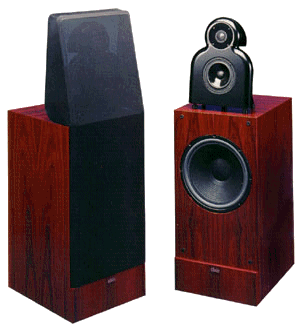
 Since Carl Marchisotto extensively upgraded my Alon IVs with Alnico
dipole tweeters, Mundorf Oil capacitors, Mundorf air-core woofer coils
and a Reference woofer crossover board derived directly from the NOLA
Studio Grand, the transformation has been remarkable. Driven by Krell
FPB-350MCX monoblocks and a Mark Levinson 326S, the speakers retain
the huge, open soundstage and ability to disappear that made the
original Alon's special, but they now offer substantially greater
resolution, separation, transient attack, bass definition and
low-level detail. The improvement isn't simply more treble or more
bass; I'm hearing deeper into recordings I've known for decades.
Since Carl Marchisotto extensively upgraded my Alon IVs with Alnico
dipole tweeters, Mundorf Oil capacitors, Mundorf air-core woofer coils
and a Reference woofer crossover board derived directly from the NOLA
Studio Grand, the transformation has been remarkable. Driven by Krell
FPB-350MCX monoblocks and a Mark Levinson 326S, the speakers retain
the huge, open soundstage and ability to disappear that made the
original Alon's special, but they now offer substantially greater
resolution, separation, transient attack, bass definition and
low-level detail. The improvement isn't simply more treble or more
bass; I'm hearing deeper into recordings I've known for decades.
Pink Floyd has been particularly useful for understanding what changed. On The Wall, tracks such as "Mother" and "Hey You" can be spectacular. "Mother" has tremendous clarity and presence, while the drums on "Hey You" have an almost startling combination of impact and definition. Vocals remain exceptionally clean even when the recording becomes dense. On "Nobody Home," I began noticing an extremely faint low-frequency thumping that I had never consciously heard before. These aren't details that sound artificially highlighted; they simply emerge naturally from a quieter, more resolved presentation.
Most striking is how dramatically the sound varies between recordings. After the powerful, well-defined bass of The Wall, Pink Floyd's A Momentary Lapse of Reason sounds surprisingly lean. At first, such differences made me question the speaker set up. Hearing the same tonal character across multiple versions of the album, however, convinced me that the Alon's were exposing differences in the recordings rather than adding their own coloration. Even within The Wall, I can now distinguish variations in vocal ambience, synthesizer texture, and individual instruments that once blended together.
"Comfortably Numb" provides another good example. The studio recording can sound somewhat bright through the upgraded speakers, yet I can now distinguish the texture of the guitar from the synthesizers and other high-frequency information surrounding it. By comparison, the live version from Pulse gives the guitar considerably more body and smoothness while retaining excellent detail. The Alon's make that contrast immediately apparent. Their enormous dipole soundstage also works beautifully with a large live recording, producing a presentation that can extend well beyond the physical locations of the speakers.
Carl's upgrades have transformed how I hear my collection. The Alon's do not make every recording sound better; they make each recording sound more like itself. Exceptional recordings can be breathtaking, with powerful dynamics, deep, controlled bass, natural vocals, and an expansive three-dimensional soundstage. Thin, bright, or congested recordings are revealed just as clearly. Before the upgrades, I often judged how good my system sounded; now I focus more on the quality of the recording and mastering. That may be the best compliment I can give Carl's work: the upgraded Alon's do not make everything sound spectacular, they make it unmistakable when a recording truly is.
David Crawford
david.crawford@wilmarinc.com
(704) 361-2660